
KEY TOPICS
- Secure care standards and change
- Neurodiversity and transitions
- Working with families through change and transitions
- The Talking Hope framework for hopeful transitions
Adolescence is a time of biological, emotional and mental change for all young people. It can be easy for adults to forget how daunting this can be. Participation is important here. Ensuring the voice of the young person is captured is essential to informing good transitions. In our recording section, the record of achievement and river of life are two tools which could be very useful for transitions, in supporting a young person to reflect positively on their life and future. Phased transitions are also preferable, in supporting young people to adjust and even benefit.
A young woman in Stepdown at St Mary’s explained to us:
“It really does depend on the way it’s done and is very much about kind of…how to describe it? It depends very much on how it’s done and who’s involved in it and the way they kind of work and get to know the young person. And that’s what I like about Stepdown, it wasnae just a straight ‘You’re going from here to here’, it’s a ‘You’re going from here to here, but we’ll do wee bits in between.’ So there was overnights involved, there was days out, there was lots of things and I got to know the staff team very, very well before I moved in, which was a really good thing.”
The same young woman shared the following art work with us, explaining that she had picked a compass design to show the importance of a sense of direction.

Secure Care Standards and Transitions
The Secure Care Standards and Pathways were created to improve outcomes and experiences for children in or on the edges of secure care in Scotland. The concept of transitions is enshrined in the standards, which are organised into before, during and after themes. Ruby Whitelaw is leading on work to embed the standards and reflected:
“Having hope for kids in secure care means planning for after the placement right from the start. We have to get creative in developing alternatives for our children in or on the edges of secure care. It is so important not to make assumptions about these children and fail to give them a chance. While we are making progress, we still have a way to go with respecting rights practice when it comes to transitions into the community.”
Neurodiversity and change
Change and transition can present particular challenges to neurodiverse young people. With transitions in, for people who struggle with sequencing and procedural learning, it can take a lot of effort to learn a new system or process. Informal or social rules may be more challenging to grasp for neurodiverse young people who may struggle with ‘reading between the lines.’ Neurodiverse people sometimes develop coping strategies for dealing with unfamiliarity. One autistic young woman explained to us:
“I have stock phrases that I use in new social situations. They are things I hear other people use in certain situations and I use them when I don’t know people or what is expected of me. It can still be a problem when somebody uses one of my stock phrases with me. Like somebody said to me recently at the end of a meeting. ‘It was nice to meet you, I hope to see you again soon.’ That is what I would normally say and I was stuck, I just had to walk away. But my stock phrases usually help me a lot.”
You can find more transition tips from the National Autistic Society here
Working with families through change and transitions
Working with families during transitions also requires getting to know what works for them. In our participation section a staff member describes working with a parent about what worked for her in meetings. All families need to understand how things work in an organisation, so they know what is expected, how they can participate and feel safe to stay connected with the young person, and staff.
This may also involve supporting a family member with their boundaries:
“We have a range of responses from families when the young person comes in here. For some families, we might not hear from them at all…no matter how hard we try. On the other hand, we had a situation recently where this 14 year old was struggling to engage in any of our programmes because his family were constantly in touch, and there was a lot going on with them. We had a meeting with the family where we explained about the work we wanted to do with their son, how he needed headspace to do that, and we worked out a way of achieving a better balance which meant that they were still an important part of his life, but he could also focus on the work he needed to do.”
Staff member at St Mary’s secure care centre
The Talking Hope framework for hopeful transitions
The diagram below captures learning from earlier phases of Talking Hope, on transitions into and out of secure care, with the Good Shepherd Centre as the lead partner at that time. The diagram captures key themes that young people and staff said were important considerations for transitions out of secure care. We added the nearest SHANARRI indicators in brackets to each theme in the diagram.
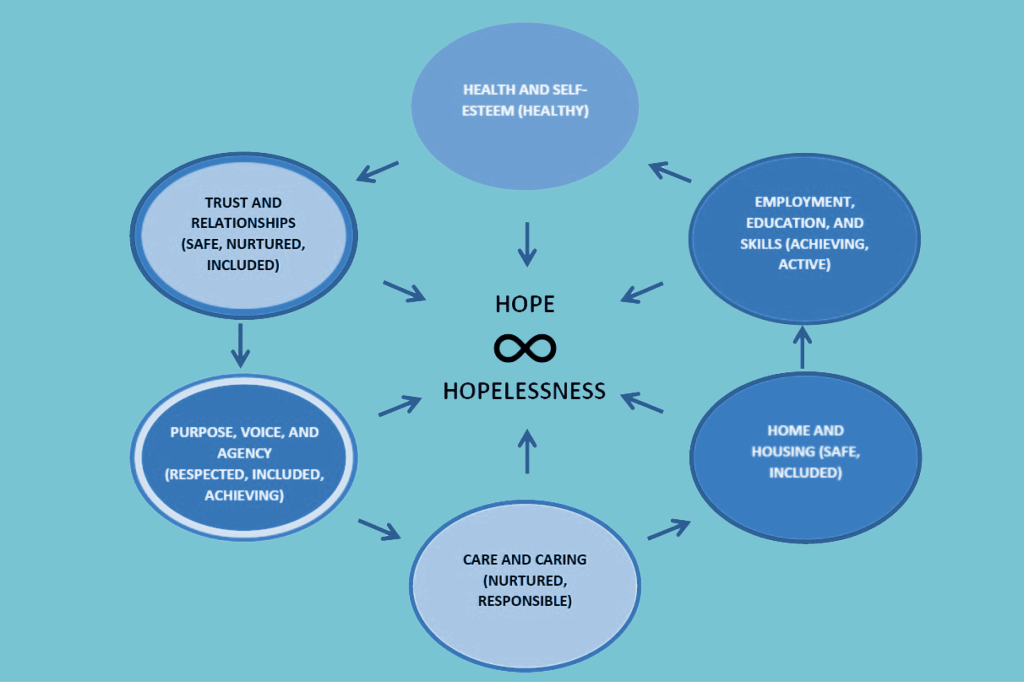
We discussed transitions in Phase three, including with staff at a recovery event in East Ayrshire.
One staff member offered an important reflection on the tendency to operate with standard assumptions about what a good life looks like and perhaps a tendency to set the bar too high:
“Services get into a way of thinking about talking about transitions to adulthood and I feel like the expectations are set too high – like we have a standard set of goals that we always refer to across agencies – to have a job or be at college, to have a particular kind of home and a car, and to have productive hobbies. Is that helpful?”
Family support team, East Ayrshire
The following are key learning points about transitions in working on this framework
- The extent to which young people coming through care emphasised that they wanted to use their lived experience to care for others / contribute to positive change was striking (care and caring)
- A sense of direction and purpose was linked to setting goals and both were important for hope
- The two main emphases in talking about transitions were the material factors or building blocks required for a good life, and the relationships and support to manage life’s challenges
You can find out more about earlier phases of Talking Hope in our report.
 talkinghope.uk