
KEY TOPICS:
- Participation, rights and hope
- Participation, agency and hope
- Hope and understanding
- Hope and boundaries
- Talking Hope Approach and participation
- Parents and participation
“It’s about creating channels in all of our organisations, to capture the voices of children and families, and make sure they influence how decisions are made.“
Eilidh, participation officer, includem
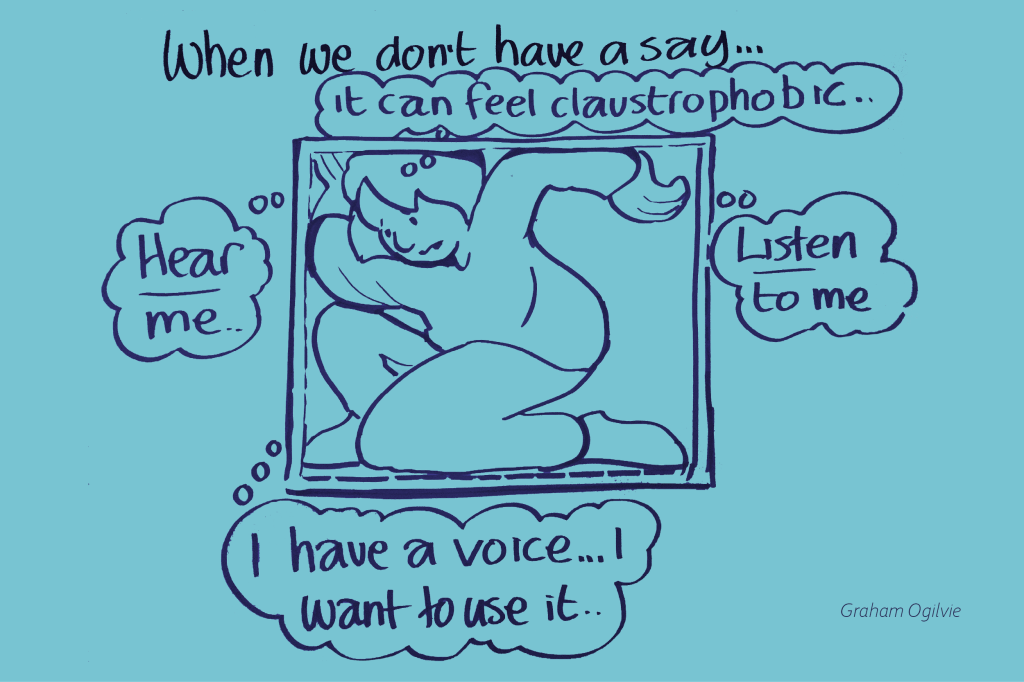
As Talking Hope has continued, there has been more emphasis on participation in policy and practice.
Participation, rights and hope
Participation is one of the guiding principles of the United Nations Convention of Children’s Rights (UNCRC). Article 12 states that children have the right to participate in decisions that affect their lives. Through participation people can also identify opportunities for action, individually and collectively.
The Scottish Parliament unanimously passed a bill to incorporate the UNCRC into Scots Law. The Children and Young People’s Commissioner protects the rights of children in Scotland.
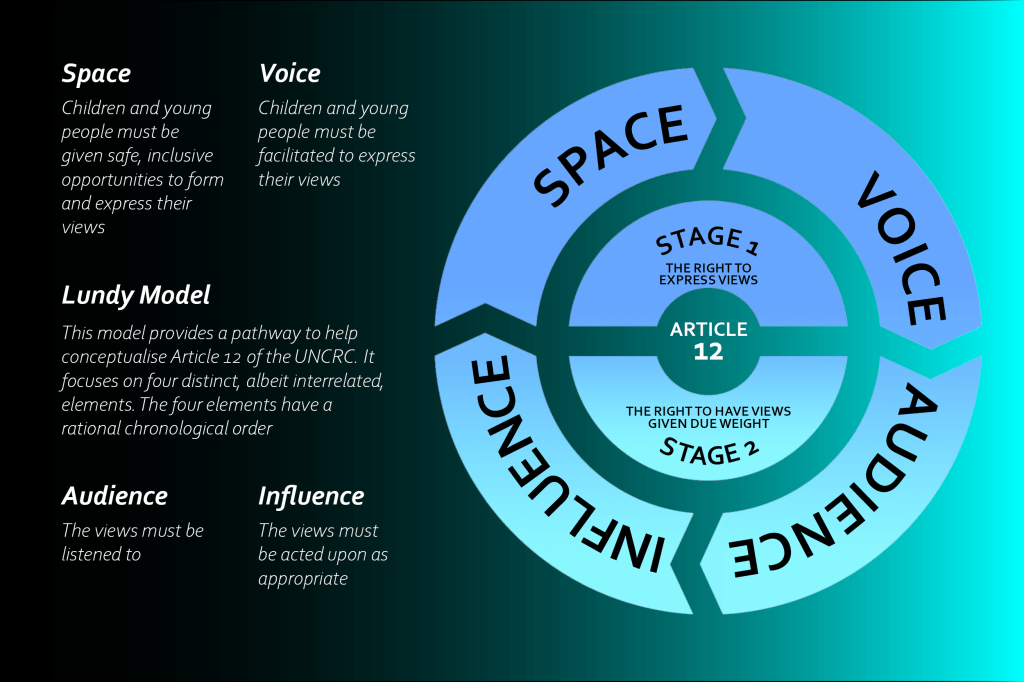
Laura Lundy has developed a model to promote Article 12 of the UNCRC, focusing on the voice of the child. Crucially, the voice should also be acted on, as appropriate (see Lundy model below).
Participation, agency and hope
Staff informed us of examples of working with each young person and family to work out what matters to them, including any support they need to be able to express their views and participate in meetings.
The concept of agency is important in considering hope, meaning here a sense that you can influence your own goals and paths. Snyder talks about agency in ‘Hope Theory: Rainbows in the Mind,’ (2002) and the importance of building confidence and motivation to achieve goals. Thinking about young people where risk is a concern, this is especially important because risk management within services can be professionally led, and involve monitoring, control and containment.
The challenge is to find ways to promote the agency, positive identity and wellbeing of young people even where there is concern about risk. Finding a voice is an important step on the way:
“So basically my first time opening up was in a meeting, a LAC [looked after child] review, and I was saying what could be better and everything, and I just sat there, and I was thinking. And I had written on a piece of paper before that, but I was scared, and then I just bit my tongue and I said it and I asked these questions… I had to find out for myself. And since then I don’t miss anything.”
Young person in the Good Shepherd Centre
Hope and understanding
Young people tell us that working out how to understand themselves, their emotions and their relationships gives them hope. Understanding other people matters too, especially because the brains of young people are rewiring, making it challenging to see other points of view and to control impulses.
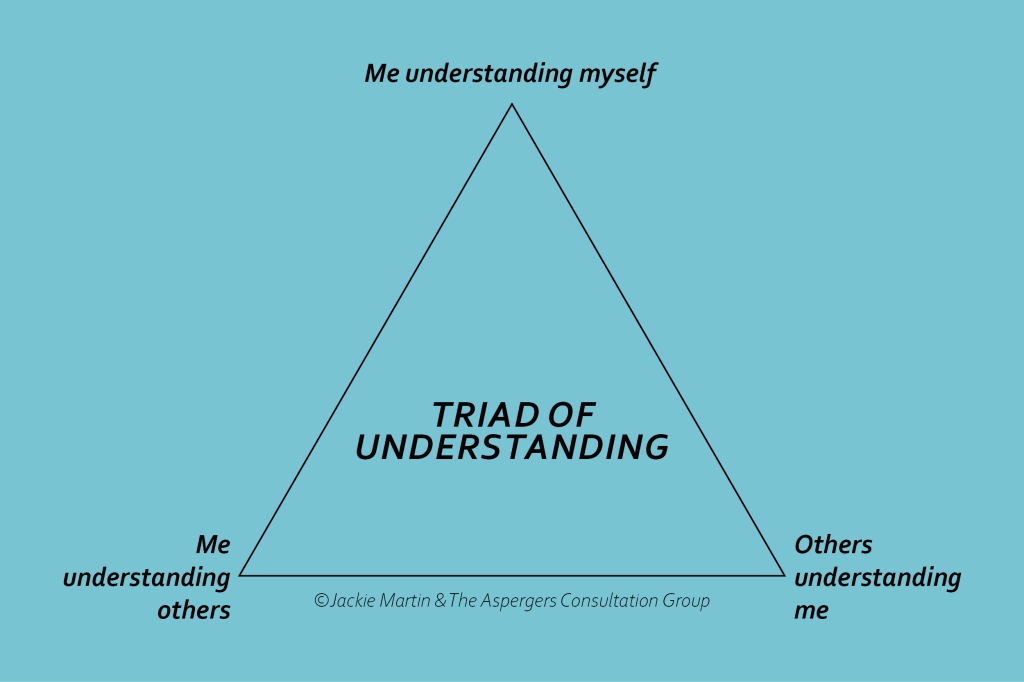
This can be more challenging still for young people who are neurodivergent and/or who have experienced trauma and adversity. Jackie Martin did research with young autistic adults. This diagram is based on what they said mattered most.
Supporting understanding is also fundamental to being trauma informed in work with children & families. The video below from the Anna Freud centre explains how trauma affects brain development and behaviour. It offers hope that understanding and trusting relationships can help.
What is written down about young people is also very important. However young people tell us that they often feel “only the bad stuff” gets into the records, leading to them feeling pre-judged. On the other hand, being actively involved in collaborative conversations, goal setting, planning, recording and enacting the plan can instill hope and is consistent with a children’s rights perspective.
Hope and Boundaries
Although positive relationships are essential for hope, it is also essential that children and adults are able to set boundaries with others, and to respect their boundaries too. It is important to talk to young people about what makes a healthy relationship and how unhealthy relationships can involve someone being coerced into doing things they aren’t comfortable with, or be made to feel they aren’t good enough. Many young people who have faced adversity may have got used to fight or flight responses and may adapt by having no boundaries or by imposing their boundaries in unhealthy ways. Parents/carers and staff may benefit from working on their own boundaries first, to be able to effectively support young people to identify, communicate and maintain theirs. Find out more here
Talking Hope Approach and participation
A key aim of Talking Hope is to promote honest and inclusive conversations among young people, practitioners and family members. This requires each individual to accept that no one person has all the answers, and that everyone can benefit from an exchange of views: read more about our approach here.
Parents and participation
“We have been working with a parent who is neurodiverse. We have had challenges developing a relationship with her… We found out through asking her about what would work better for her in having meetings in the centre, that she wanted a chair that she could bounce in and fidget in. It had never occurred to her that we would pay attention to her needs to enable her to take part. Her knowledge of her son hadn’t been coming into play. There was relief in her voice during that conversation. And during the next meeting she spoke so thoughtfully. For us too, there were great insights about tiny things we could do that would make things better for her son. It was… about small things that involved thinking outside the box. I came away thinking what a simple conversation that was and found later that it made a huge difference to family involvement”
Participation worker at St Mary’s talking about work with a parent
We worked with includem on a separate project to Talking Hope to work out what worked for parents of supported children and young people. You can read about the views of parents here.
In East Ayrshire there was a shift during phase 3 to developing hubs for localised support for children and families. You can read about their person-centred approach to commissioning services in our blog.
Two key additional themes that young people, families and partners identified as important in relation to participation were the need for specific support to overcome communication difficulties and the importance of participation in what gets recorded in services:
PARTICIPATION THEMES
Communication support
About supporting young people, and families who may have additional challenges with communication
Participation and recording
About ensuring that the voices of supported people are captured and influence decisions, and that records are strengths based
 talkinghope.uk