
KEY TOPICS:
- Record of achievement
- Different approaches to timelines
- River of Life
- Language
“Sometimes you get this feeling when you meet someone for the first time, that they have judged you based on what they have read about you. And when you feel judged like that you think ‘ken what, I’m going to act the way you are expecting’ and you do something just because you know that’s what they think of you anyway”
Secure care experienced young adult
Young people and families have told us that they often don’t trust records that are held about them by services. Their experience of records sometimes feels too negative, with no positives noted about their lives and achievements. Strengths-based recording takes different forms, and can link to the idea of creating a hope reservoir that young people can draw on when they need to feel more hopeful
The following parents supported by includem offered their advice on how recording should be:
“Although you need to assess struggles people are having, you want people to go away feeling better – you cover the issues that need to be covered but you acknowledge what people are achieving too.”
Parent supported by includem
“Social care is too driven by tick boxes and fitting a round peg in a square hole. That is what needs to change…. They need to look at how does that person present themselves – what are their particular needs. No tick boxes.“
Parent supported by includem
In our participation page we talk about Laura Lundy’s work on children’s rights, and the principle that it is not enough to give children a voice; we also need to respond to what they tell us. It is important that the child’s view is recorded as part of decision-making, including in plans for the child or young person.
Our partners were all working in different ways on improving recording practice, with examples below.
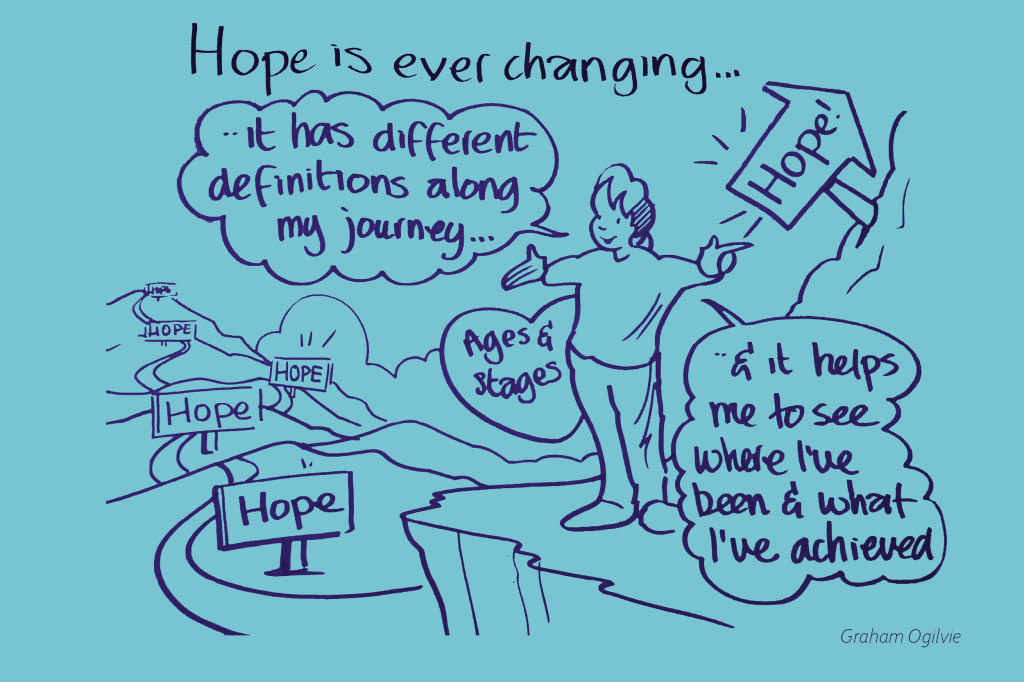
Record of achievement
Elaine Hamilton, Service Manager at St Mary’s Kenmure, reflects here on different forms of recording achievements for young people:
“The young people were involved in doing Records of Achievement. We asked them to think about – on a monthly basis – what have you achieved this month, and then we asked the staff to do it for them as well. So, we put them together and, quarterly, we used to make PowerPoint presentations of all their achievements; there would be photographs of it, there would be music attached to it, there might be videos in it, there would be staff congratulating them on maybe getting something at school.”
A full account from Elaine of records of achievement is available here.
Different and hopeful approaches to timelines
Timelines are an established tool in services, which can be used for different audiences, to draw attention to the key events in a child’s life which have brought them to where are they are now.
Talking Hope partners described work with young people to co-produce visual records of a young person’s life in ways that supported the young person to understand their life better, and which could be shared with others to help them understand the young person better too.
River of Life
“But once you’ve done it [River of Life], it’s looking at the overall picture. I would definitely say it’s a much easier way to look at the lifetime between being born and the age I am the now, and looking at actually how many positive things there are. And as well, even though there’s so many positives, there are the wee bit negative things there as well, but it’s good to see, like, that things do get better.”
Young person in stepdown at St Mary’s
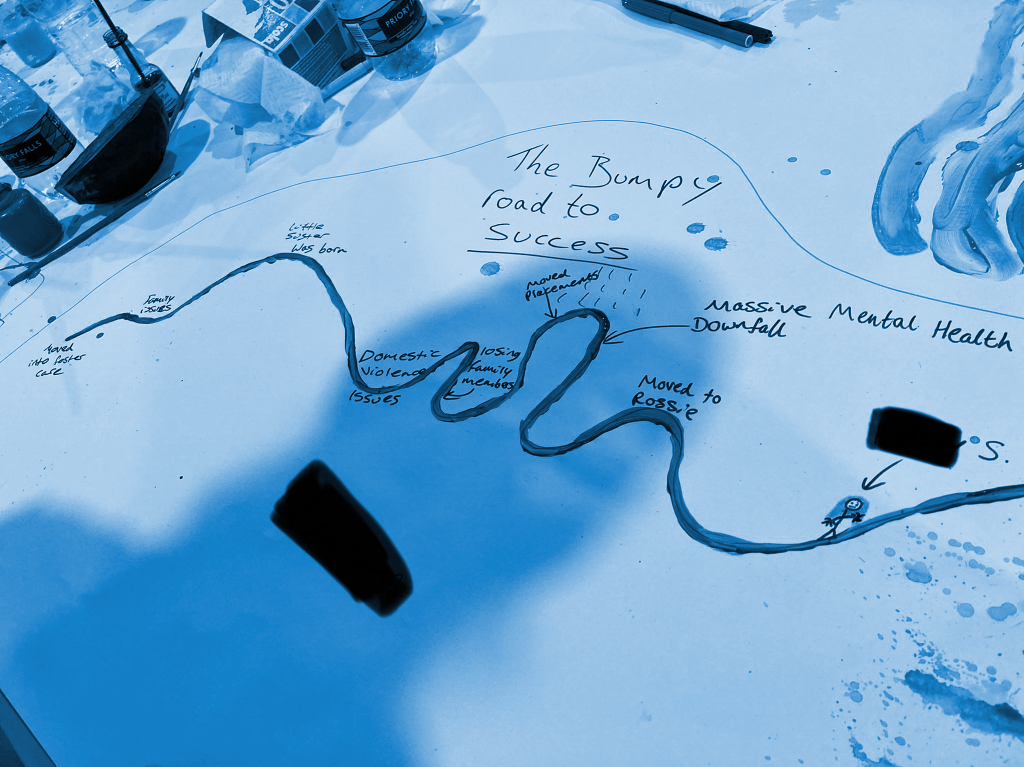
The River of Life is a version of a timeline or a metaphor for someone’s journey originally developed by Joyce Mercer at Yale University in the US. It is a reflective tool that only needs a pen and blank sheet of paper. The river idea helps to convey that life is not a straight line, and encourages the people working on it to think about the bends along the way, the turning points and the key relationships that made a difference. It can help to integrate past, present and future and can be used to build hope. You can also include wider events such as the pandemic.
The following example of a visual record is similar to a River of Life and was recorded with a young person in Rossie secure care centre as part of the articulate project in the centre.
Language
Hopeful recording also means being mindful of the language used, avoiding professional jargon and encouraging young people to feel comfortable with saying when they don’t understand. Rossie produced a language guide shortly before joining Talking Hope. While Rossie still promote the guide, they are also clear that language needs to be checked with each individual young person as different words can take on particular meanings for particular young people, based on their background and experience:
“We worked with a girl who got more confident being able to tell us how she felt about things we were saying. A major one was that we thought we had made progress by switching from saying ‘time out’ for someone who needs time to settle down a bit – to saying ‘time away.’ We thought it sounded less punitive and some young people preferred it. For this girl, who had experienced a lot of rejection in her life, it was a threatening word. So we used ‘time in’ and she was much happier with it.”
Senior support worker, Rossie secure care centre
 talkinghope.uk